If your dryer is taking two cycles to dry a load that used to finish in one, your dryer vent is telling you something. In Dallas, TX, where summer heat, high humidity, and year-round pollen create conditions that accelerate lint buildup, ignoring your dryer vent is not just an efficiency problem. It is a fire risk.
Most Dallas homeowners clean their dryer vent far less often than they should. This guide covers exactly how often to clean your dryer vent in the DFW area, what factors change that schedule, and how to tell when you are already overdue.
Here is what this guide covers:
- The recommended dryer vent cleaning schedule for Dallas, TX homes
- How Texas heat, humidity, and home type affect your cleaning frequency
- Warning signs that your vent needs immediate attention
- What professional cleaning actually involves and why DIY has limits
- What dryer vent cleaning costs in the Dallas-Fort Worth area
How Often Should You Clean Your Dryer Vent in Dallas, TX?
Most homes in the Dallas-Fort Worth area should have their dryer vent professionally cleaned once a year. That is the baseline recommendation from the U.S. Fire Administration and most national fire prevention guidelines.
But for many DFW households, once a year is not enough. Texas homes run dryers hard. Larger families, frequent laundry cycles, and the region’s unique environmental conditions all push lint buildup faster than the national average assumes.
A more practical breakdown looks like this:
- Every 6 months: large families (4+ people), pet owners, or homes with long vent runs through an attic or roof
- Every 6 to 9 months: average DFW households with moderate laundry use
- Every 12 months: smaller households in newer construction with short, direct vent lines
- Quarterly cleaning: households running more than 5 loads per week, or rental properties and multi-family units with shared laundry access
When in doubt, lean toward cleaning more often rather than less. The cost of a professional cleaning ($100–$200 in the Dallas area) is far lower than the cost of a dryer fire or a premature appliance replacement.
Why Dallas Homes Need More Frequent Dryer Vent Cleaning Than Average
Dallas is not the average American city when it comes to home maintenance, and your dryer vent schedule should reflect that.
Texas heat is the first factor. DFW summers push outdoor temperatures well above 100°F. When hot, humid air from outside interacts with a partially blocked vent, moisture gets trapped inside the vent line. That moisture causes lint to clump and stick to vent walls rather than blow through cleanly. A vent that would stay clear for 14 months in a cooler climate may clog in 8 months in North Texas.
High humidity during DFW summers compounds this. Humid air moving through a vent line condenses more easily, especially in attic vent lines where temperature swings are extreme. The result is damp lint that adheres to vent walls. Damp lint is both harder to remove and more prone to mold growth.
Pollen season in Dallas is aggressive. Cedar fever season and spring pollen season introduce fine airborne particles that enter the dryer exhaust system and mix with lint. Homes near green spaces or older neighborhoods with large tree canopies see measurably heavier debris accumulation in exterior vent caps.
Older Dallas homes present a different structural challenge. Many homes built before the 1990s have vent runs with multiple bends, longer-than-recommended vent paths, or vent lines that were routed through interior walls and attics because that was the easiest path at the time. Every bend in a vent line creates a low-flow zone where lint collects. A vent with three or four bends may need cleaning twice as often as a short, direct run.
Hard water in DFW is a less obvious factor. Hard water leaves mineral deposits in appliances, and over time it can affect the mechanical parts of your dryer as well as the exhaust moisture levels. Homes using well water or in parts of the Metroplex with especially hard municipal water often see heavier residue inside vent systems.
Warning Signs Your Dryer Vent in Dallas Needs Cleaning Now
You should not wait for your scheduled cleaning if your dryer is showing these symptoms. They indicate the vent is already partially or fully blocked.
Clothes are taking longer to dry.
A single cycle should dry a normal load. If you are running two or three cycles, restricted airflow is the most common cause, and a clogged vent is the most common cause of restricted airflow.
Clothes come out hot but still damp.
This is a specific sign of a blockage near the exterior end of the vent. Heat is building up inside the drum because it cannot escape, but moisture is not being carried out either.
The dryer shuts off mid-cycle.
Most modern dryers have a thermal shutoff that activates when the appliance overheats. If your dryer is stopping before the cycle ends and restarting once it cools, that is a direct safety response to a blocked vent, and it means your dryer is already operating in a dangerous range.
Excess lint behind the dryer or around the lint trap area.
Lint that cannot exit through the vent has to go somewhere. If you are finding lint accumulation in places beyond the trap itself, the vent line is backing up.
The outside vent hood flap is not opening during operation.
Run your dryer and go outside to check the exterior vent cap. If the flap is not moving or only partially opening, airflow is too restricted to push it open. A fully clogged vent will show no movement at all.
Your laundry room feels hotter than usual.
Excess heat escaping around the dryer connection point or through the appliance housing is a warning that the vent system is not exhausting properly.
A burning smell during operation.
This is an urgent sign. Flammable lint inside a hot vent line can ignite. If you smell burning from your dryer and it is not a new appliance burning off factory residue, stop using it and call a professional immediately.
What Happens If You Skip Dryer Vent Cleaning in Texas
The U.S. Fire Administration reports that dryers cause approximately 2,900 home fires annually in the United States, and lint is the leading cause. That is not a dramatic statistic. It is a consistent, preventable pattern.
In the Dallas-Fort Worth area, the fire risk is real. The combination of heavy dryer use, hotter ambient temperatures, and longer vent runs in many DFW homes creates conditions where lint fires can develop faster than they would in cooler climates. Lint in a hot vent line is highly flammable. When airflow is restricted and heat builds up with nowhere to escape, the temperature inside the vent can reach ignition point.

Beyond fire risk, a clogged vent has quieter consequences that cost money over time. Restricted airflow means your dryer works harder and longer to do the same job. That adds directly to your utility bills. A heavily clogged vent can increase drying energy use by 30% or more. It also puts mechanical strain on the motor, heating element, and drum bearings. Appliance longevity suffers. A dryer that should last 10 to 13 years may need major repairs or full replacement in 7 or 8 years if the vent system is never properly maintained.
Moisture buildup is another consequence that rarely gets attention until it becomes serious. A blocked vent traps humidity inside the vent line and can push it back into the laundry room. Musty odors, mold growth around the dryer connection point, and elevated indoor humidity are all signs that the vent is not exhausting moisture effectively.
Professional Dryer Vent Cleaning vs. DIY: What Dallas Homeowners Need to Know
Cleaning your lint trap after every load is essential, but it does not replace a professional vent cleaning, and it does not address the lint that accumulates inside the vent line itself.
DIY dryer vent cleaning kits are sold at hardware stores and consist of flexible rods with a brush attachment. They work reasonably well on short, straight vent runs. For a dryer vented directly through an exterior wall with a run of 5 feet or less and no bends, a DIY kit can help extend time between professional cleanings.
That describes a minority of Dallas homes.
Most DFW homes have attic vent lines, roof vent lines, or vents routed through multiple bends to reach an exterior exit point. Flexible rods from a hardware kit cannot navigate multiple bends without losing friction or getting stuck. They also cannot measure airflow to confirm the vent is actually clear; they can only push through what the brush reaches.
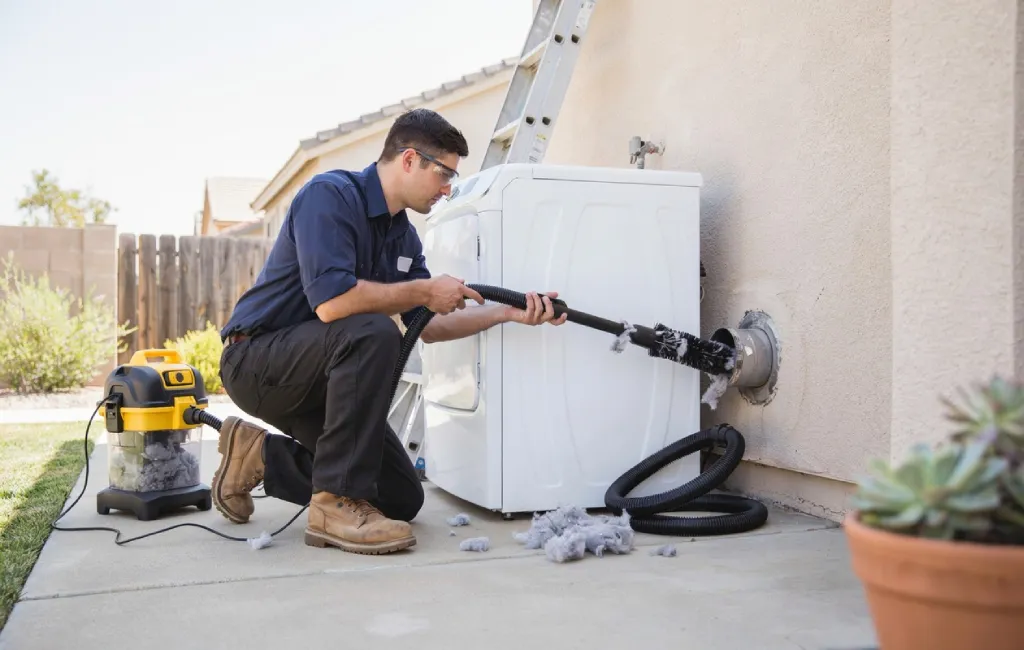
Professional dryer vent cleaning uses high-powered vacuum equipment combined with flexible rods and specialized brushes designed for longer, more complex runs. A professional service will also inspect the exterior vent cap, check for crushed or kinked sections of flex duct, and measure airflow before and after cleaning to confirm the job is complete. That airflow measurement is something no DIY kit can replicate.
For homes with roof vent lines in particular, a professional service is not optional. It is a safety requirement. Working on a roof in Dallas summer heat to clean a vent that may be inaccessible from inside the attic is a job for someone with the right equipment and insurance.
Professional dryer vent cleaning in Dallas typically costs between $100 and $200, depending on vent length, accessibility, and whether the exterior cap needs repair or replacement. That cost covers one full vent system cleaning, inspection of the vent path, and confirmation of restored airflow.
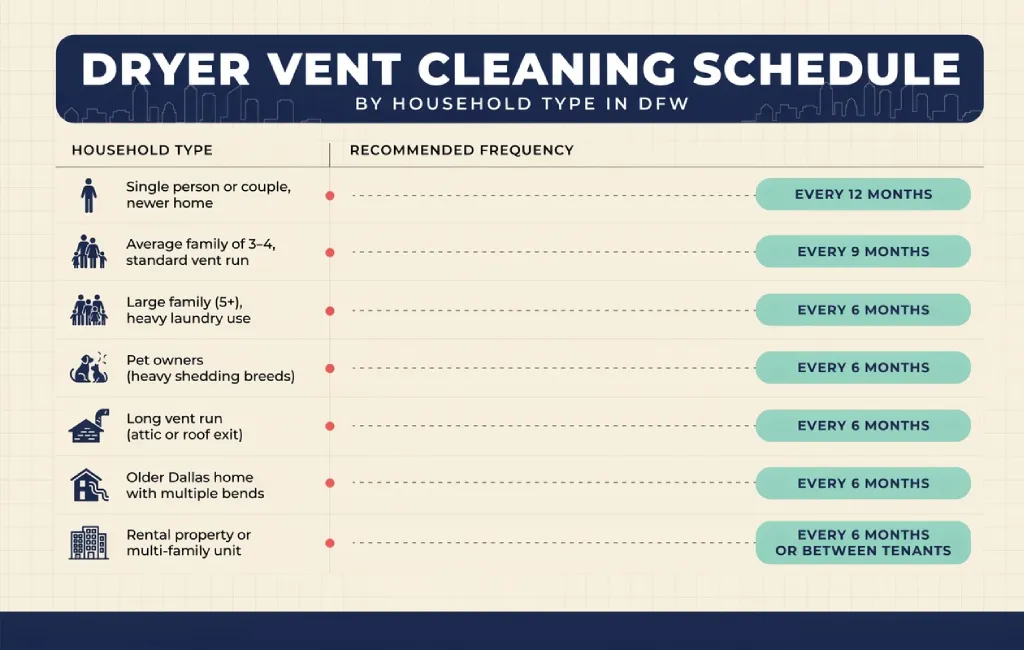
Dryer Vent Cleaning Schedule by Household Type in DFW
Different households have genuinely different needs. Here is a practical guide based on common DFW home situations.
| Household Type | Recommended Frequency |
| Single person or couple, newer home | Every 12 months |
| Average family of 3–4, standard vent run | Every 9 months |
| Large family (5+), heavy laundry use | Every 6 months |
| Pet owners (heavy shedding breeds) | Every 6 months |
| Long vent run (attic or roof exit) | Every 6 months |
| Older Dallas home with multiple bends | Every 6 months |
| Rental property or multi-family unit | Every 6 months or between tenants |
If your household falls into more than one high-frequency category (for example, a large family in an older home with a roof vent line), err on the side of every 6 months as a hard rule rather than a guideline.
When Is the Best Time to Schedule Dryer Vent Cleaning in Dallas?
Spring is the most strategic time for an annual dryer vent cleaning in the Dallas area. Cleaning before DFW summers begin means your dryer enters the highest-demand season in the best possible condition. Summer laundry loads are heavier. More clothing from outdoor activities, towels from pools, and kids home from school all increase laundry frequency.
Fall is the right time for a second cleaning if your household warrants a semi-annual schedule. Cleaning before the holiday season and the period of peak laundry activity sets you up for the months when dryers typically get their heaviest use.
Homes that schedule dryer vent cleaning during these windows tend to catch problems before they develop into emergencies. Spring cleaning also aligns naturally with post-cedar fever season, when pollen and debris accumulation in exterior vent caps tends to be at its highest.
If you have never had your dryer vent professionally cleaned, regardless of season, now is the right time. There is no bad month to restore proper airflow to a clogged system.
If you are already noticing signs of restricted airflow, Lara’s Air Duct Cleaning serves the Dallas-Fort Worth area and can inspect and clean your dryer vent system before a slow-building problem becomes an urgent one.
Why Lara’s Air Duct Cleaning Is the Right Choice for Dryer Vent Service in Dallas
Lara’s Air Duct Cleaning has built its reputation in the DFW Metroplex by doing the work correctly rather than quickly. Here is what that means for your dryer vent service:
- Local expertise in DFW home construction. We understand the vent configurations common in Dallas-Fort Worth homes: attic runs, roof exits, and older duct paths with multiple bends. We have the equipment to clean them thoroughly.
- High-powered professional equipment. Our cleaning systems go well beyond what hardware store kits can do. We remove lint from the full vent line, not just the accessible section, and we measure airflow before and after every job.
- Exterior vent cap inspection included. Many companies skip the outside. We check the vent cap on every job because a damaged or debris-blocked cap is one of the most common causes of recurring buildup.
- Transparent pricing with no surprises. Our dryer vent cleaning is priced clearly before the job starts. No add-ons you did not agree to, no upselling mid-service.
- Service across the Dallas-Fort Worth area. We serve Dallas, Fort Worth, and communities throughout North Texas. If you are in the DFW area, we can help.
Your dryer works hard for your household. So does your vent system. We make sure both are operating safely.

Frequently Asked Questions
How often should I clean my dryer vent in Dallas, TX?
Most Dallas homeowners should clean their dryer vent every 6 to 12 months, depending on household size, vent length, and laundry frequency. Large families, pet owners, and homes with attic or roof vent runs should clean every 6 months. Smaller households with short, direct vent runs may be fine at 12 months.
What are the signs that my dryer vent is clogged?
The most common signs are longer drying times, clothes that feel hot but stay damp, a dryer that shuts off before the cycle ends, excess lint accumulating around the dryer, a laundry room that feels hotter than usual, and a burning smell during operation. Any of these warrants immediate inspection.
Does Texas humidity affect how often I need dryer vent cleaning?
Yes. High humidity during DFW summers causes lint to clump and stick to vent walls rather than blow through cleanly. This accelerates buildup compared to drier climates and is one reason many Dallas homeowners need more frequent cleaning than the national once-a-year recommendation.
Can I clean my dryer vent myself?
DIY kits work on short, straight vent runs of 5 feet or less with no bends. Most DFW homes have longer runs, attic routing, or multiple bends that DIY kits cannot fully clear. A professional service uses high-powered equipment, can navigate complex vent paths, and measures airflow to confirm the vent is actually clear, not just partially brushed.
How much does dryer vent cleaning cost in Dallas?
Professional dryer vent cleaning costs in the Dallas area typically range between $100 and $200. The price depends on vent length, accessibility, and whether any components need repair or replacement. That cost is a small fraction of what a dryer fire, premature appliance replacement, or elevated energy bills will cost over time.
Conclusion
Your dryer vent is one of the most overlooked maintenance items in a Dallas home, and one of the most consequential when ignored. The combination of Texas heat, high summer humidity, heavy laundry use, and the architectural realities of many DFW homes creates conditions where lint builds up faster and causes problems sooner than most homeowners expect.
A proper cleaning schedule, every 6 months for high-use households and every 12 months at the minimum for everyone else, keeps your dryer running efficiently, extends its lifespan, reduces your energy bills, and most importantly, removes the lint fire hazard before it becomes dangerous.
The next step is simple. If you cannot remember the last time your dryer vent was professionally cleaned, or if you have noticed any of the warning signs covered in this guide, it is time to schedule a service.
Lara’s Air Duct Cleaning serves Dallas, Fort Worth, and the DFW Metroplex. Visit our Richardson office or call us to schedule your dryer vent cleaning and get your system back to safe, efficient operation.