
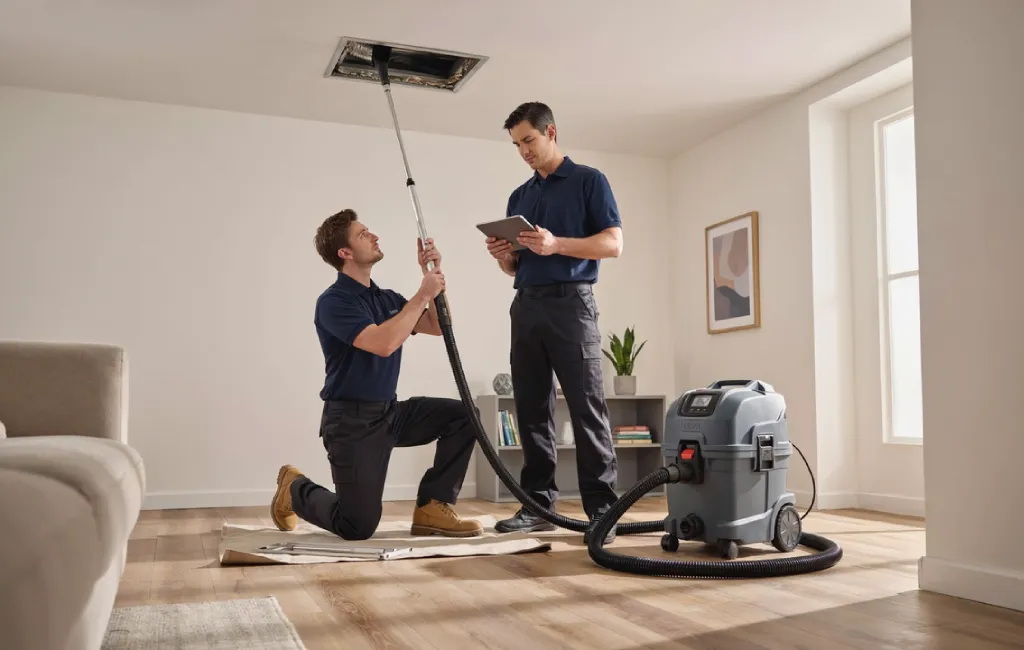
You’ve decided to have your air ducts cleaned. Maybe it’s been years since the last service, someone in your household has allergies, or a technician flagged it during an HVAC tune-up. Whatever brought you here, you’re now looking at a list of local companies and wondering which one you can actually trust inside your home.
Before you book anyone, there are ten specific essential questions to ask before hiring an air duct cleaning company. The answers will tell you whether you’re dealing with a qualified professional or a company that will take your money, do incomplete work, and leave before you realize it. At Lara’s Air Duct Cleaning, we’ve answered these questions from thousands of customers, and we believe an informed customer is the best kind.
Most homeowners don’t know what separates a legitimate duct cleaning company from a cut-rate operation until after the job is done and something seems off. By the time that happens, the technician is gone, your check has cleared, and your options are limited. Asking the right questions before anyone sets foot in your home takes less than ten minutes and can save you hundreds of dollars, protect your HVAC system, and give you genuine peace of mind about your indoor air quality.
Here is what this guide covers so you can hire with confidence:
- The credentials and insurance documents you should request before any work begins, and why verbal assurances are not enough.
- What equipment a legitimate duct cleaner uses, and the single equipment question that separates professionals from cut-rate operators.
- How to recognize bait-and-switch pricing before you’re already committed.
- What the EPA actually says about air duct cleaning and chemical treatments, in plain language.
- A post-cleaning verification checklist so you know the job was done right before the technician drives away.
Are You NADCA Certified, and Can I See Proof?
NADCA (National Air Duct Cleaners Association) certification is the primary professional credential standard in the duct cleaning industry, and it’s the first thing you should ask about. When a company says they are NADCA certified, ask them for their NADCA member number and look it up yourself at nadca.com. That verification step takes under two minutes and immediately separates companies with active membership from those borrowing the name.
The distinction between a company that claims to “follow NADCA standards” and one that actually holds NADCA membership matters more than it might seem. NADCA membership requires companies to employ at least one credentialed technician and carry liability insurance. A company that invokes the name without membership cannot be held to those requirements.
| Response | What It Means |
|---|---|
| “Yes, here is our NADCA member number, you can verify it at nadca.com.” | Good answer. Verify it independently. |
| “We follow NADCA standards.” (no member number provided) | Red flag. “Following standards” without membership is not the same thing. |
| “We’re certified” with only a logo on a business card or website | Red flag. A logo is not a membership certificate. |
Do You Carry Liability Insurance and Workers’ Compensation, and Will You Send Me the Certificate?

Duct cleaning insurance in the form of general liability coverage and workers’ compensation is not optional documentation, it is your protection if something goes wrong. Before any technician enters your home, ask the company to email you a Certificate of Insurance (COI) directly from their insurer. A verbal “yes, we’re insured” is not proof. A logo on a website is not proof. An actual COI is proof.
| Type of Coverage | What It Protects You Against | What to Request |
|---|---|---|
| General Liability Insurance | Property damage caused by the technician during cleaning (damaged ductwork, flooring, or HVAC components) | COI listing business name, policy number, coverage amounts, and effective dates |
| Workers’ Compensation | Injury to a technician that occurs inside your home; without this, an injured worker may have grounds to pursue a claim against your homeowner’s insurance | COI showing workers’ comp as a separate line item |
What Type of Vacuum Equipment Do You Use, and Is It Truck-Mounted?
The equipment question is the single fastest way to identify whether a company is equipped to do the job correctly. Ask directly: “Is your primary vacuum unit truck-mounted or portable?” A truck-mounted vacuum generates the level of suction required to create true negative air pressure across a whole-house duct system. A portable vacuum unit does not.
| Truck-Mounted Vacuum | Portable Vacuum Unit | |
|---|---|---|
| Suction Capacity | High CFM, sufficient for whole-system negative pressure | Low to moderate CFM, insufficient for whole-system cleaning |
| Debris Containment | Debris is pulled to a sealed unit outside the home | Debris may redistribute inside ducts or living space |
| Negative Pressure Achieved | Yes, across the full system | Rarely, if ever |
| Typical Use Case | Complete whole-house duct cleaning | Limited spot cleaning or small systems |
| Red Flag Signal | None, this is the professional standard | Red flag when presented as adequate for whole-house service |
What Does Your Cleaning Process Include, and Does It Cover Every Register and Vent?
A complete whole house duct cleaning covers every component of your air distribution system, not just the main trunk lines. Before you agree to any service, ask the company to tell you exactly which components are included in the price they quoted. A company doing the job correctly should be able to answer this without hesitation.
A complete whole-house duct cleaning process should include all of the following:
- Supply ducts throughout the home
- Return ducts throughout the home
- All supply and return registers and grilles (removed, cleaned separately, and reattached)
- Main trunk lines
- Air handler or furnace compartment, where accessible
- Drip pans, where accessible
If a company’s scope of work omits any of these, particularly registers and vents cleaning, you are not receiving a whole-house cleaning regardless of what the invoice says.
Will You Do a Visual Inspection Before and After the Cleaning, and Can I See the Documentation?
Before and after documentation gives homeowners the most objective proof available. A camera inspection at the start of the job shows the real condition of the system before anyone touches it. Photos at the end prove the work actually got done.
Together, these give you a factual record instead of just a technician’s word. Before and after photos should be a standard part of the service, not a premium add-on. Skipping this step is one of the most common air duct cleaning scams in Dallas homeowners run into.
Before the technician leaves, run through this post-cleaning verification checklist:
- Review before and after photos together while the technician is still present so questions can be addressed immediately.
- Confirm every supply and return register has been reattached and is fully secured.
- Walk to several vents throughout the home and verify that airflow is consistent at each one.
- Confirm the HVAC system was run after the cleaning was completed.
- Request the written record of work completed before signing off on final payment.
How Is Your Pricing Structured, and Will I Receive a Written Estimate Before Work Begins?
Bait-and-switch pricing is the most documented consumer protection problem in the duct cleaning industry, and it follows a predictable pattern. Understanding the mechanics, not just the name, is what lets you recognize it before you’re already committed. The question to ask is direct: “What is the total price to clean my entire system, including all vents, registers, and the air handler, and will that be in writing before you begin?”
| Legitimate Estimate | Red Flag Quote | |
|---|---|---|
| Pricing basis | Per job, based on system size assessed before quoting | Per vent, or whole-house price without itemization |
| What is included in writing | All components listed explicitly | Vague scope (“whole house”) without specifying what is included |
| Extra charges disclosed upfront | Yes, all potential add-ons disclosed before work begins | No mention of add-ons until technician is inside your home |
| Written guarantee included | Yes, with defined scope and duration | “Satisfaction guaranteed” with no specifics |
How Long Has Your Company Been in Business, and Can You Provide References?
A company that’s been at the same name and location for years means something in this industry, since fly-by-night operators are a real problem. This isn’t about ruling out newer companies. It’s about a specific pattern: fraudulent operators tend to cycle through business names and service areas to dodge bad reviews and complaint records.
A company with five or more years under the same name deserves more trust upfront than one with no track record at all. This is one of the warning signs to watch for before you book anyone.
Before you call a reference, prepare three specific questions. These get you real answers, not just a general “yes, they were fine”:
- Did the technician explain what they were doing and why at each stage of the job?
- Were there any additional charges beyond the original written estimate?
- Would you book this company again, and what specifically would make you hesitate?

Will You Protect My Home During the Cleaning Process, and What Should I Do Before Your Technicians Arrive?
Protecting home during professional duct cleaning is a topic that receives almost no attention in competing content, which means homeowners often arrive at the appointment with no idea what to expect and no framework for identifying when something is wrong. A reputable company has a clear protocol for home protection that technicians follow on every job, without being asked.
What a Responsible Duct Cleaning Company Should Do to Protect Your Home
Before work starts, technicians should lay protective floor coverings from the entry point all the way to the HVAC system and any work areas. They should also seal the vacuum connection point at the duct system. This keeps the negative pressure pulling debris toward the collection unit instead of into your living space.
These aren’t premium extras. They’re standard practice for any company using professional-grade equipment correctly.
If a technician starts work without laying down floor protection, treat that as a signal. Ask them to stop and put protection down first. A properly trained company won’t push back on that request, and this is exactly the kind of thing our how to choose an air duct cleaning company guide covers in more detail.
Why Lara’s Air Duct Cleaning Is the Right Choice for Your Home
When you’re inviting a technician into your home, you need a company that answers every question without hesitation. Lara’s Air Duct Cleaning is built on professional equipment, trained staff, and a process you can verify at every step.
- Truck-mounted vacuum system. Professional-grade suction creates true negative air pressure across your entire duct system, not a portable unit that just moves debris around.
- NADCA-certified technicians. Every technician meets the industry’s highest tested credential standard, verified independently, not just a company badge.
- Full-time employed technicians. Trained, accountable staff on our payroll, not day-rate subcontractors, so you get consistent quality and a clear path if anything goes wrong.
- Before and after photo documentation. Visual proof of completed work on every job, so you see exactly what was done.
- Written estimate before work begins. The price we quote is the price on the invoice, with no per-vent surprises once we’re inside your home.
FAQs
Q: How do I know if my air ducts actually need cleaning, or if the company is just pushing a service I don’t need?
The EPA identifies three conditions that clearly warrant duct cleaning: substantial confirmed mold growth inside the duct system or on HVAC components, vermin infestation inside the ducts, or ducts visibly clogged with debris that is actively releasing particles into your living space. If none of those conditions exist, cleaning may still be reasonable given your home’s age, recent renovation activity, or occupants with respiratory sensitivities, but no company should recommend service without first inspecting your actual system and telling you specifically what they found.
Q: What is a realistic price range for whole-house air duct cleaning, and how do I know a quote is legitimate?
A professionally performed whole-house air duct cleaning on a standard single-family home typically runs between $300 and $500, though regional variation is significant and larger or more complex systems cost more. Any quote advertising whole-house cleaning for $49 to $99 is a strong indicator of portable equipment, incomplete scope, or a bait-and-switch setup where additional charges will be presented once the technician is already working inside your home.
Q: Can duct cleaning help with allergies or respiratory symptoms?
Removing accumulated dust, debris, and allergens from duct surfaces reduces the amount of particulate matter the system circulates through your home, which may benefit occupants with allergies or asthma. The scientific evidence for a direct, measurable reduction in allergy symptoms as a specific result of duct cleaning is not conclusive, and any company that guarantees health outcomes without first inspecting your system is overstating what the evidence supports. If indoor air quality is a primary concern, also consider upgrading your air handler filter and having the full HVAC system inspected by a licensed technician.
Q: How long does professional air duct cleaning take, and do I need to leave my home during the service?
A full cleaning for a standard single-family home usually takes two to four hours, depending on the system size and how much buildup there is. Check our guide on how long air duct cleaning takes in Texas for a closer breakdown by home size.
You don’t need to leave the house during the process, but it will be noisier than usual, and some fine dust may show up near the work areas. If anyone in your home has severe respiratory sensitivities, stepping out for a few hours during the cleaning is a reasonable precaution.
Q: What happens if the company damages my HVAC system or ducts during the cleaning?
Document any damage with photographs immediately, notify the company in writing the same day, and ask for their insurance carrier’s contact information so you can open a claim directly if needed. Before any appointment, note the existing condition of accessible duct sections and HVAC components so you have a clear baseline if a dispute arises. A company carrying legitimate liability insurance with full-time employees rather than subcontractors will have a straightforward accountability path when something goes wrong.
Conclusion
Hiring the right air duct cleaning company comes down to asking the right questions before anyone sets foot in your home, and knowing what to do with the answers you receive.
The credentials come first: NADCA certification verified by member number, liability insurance and workers’ compensation confirmed by an actual certificate of insurance, and full-time employed technicians rather than subcontractors are the baseline, not a premium. A company that hedges on any of these has told you something useful before the appointment even begins.
The equipment and process determine whether the job is real: truck-mounted vacuum systems generating true negative air pressure, agitation tools used throughout the complete system.
