
You found a flyer on your door last week: “Whole-house air duct cleaning, $49, one day only.” Now you’re wondering whether that was a deal you missed or a scam you dodged.
It was almost certainly a scam you dodged. And the fact that you’re not sure is exactly what a small number of dishonest operators count on.
How to choose an air duct cleaning company in Texas comes down to five things you can verify before anyone sets foot in your home: proper certification, the right equipment, Texas licensing, liability insurance, and a written estimate with no hidden fees. Every one of those standards is checkable in advance, and a legitimate company will welcome the questions. At Lara’s Air Duct Cleaning, we’ve built our entire business around being the kind of company we’d want to hire ourselves, and that starts with being completely transparent about what good service actually looks like.
Here is what this guide will walk you through:
- The one industry certification that separates trained duct cleaners from unskilled laborers, and how to verify it in under two minutes
- Why truck-mounted vacuum systems matter, and what it signals when a company shows up without one
- How Texas licensing and insurance requirements protect you specifically as a homeowner in this state
- The exact warning signs of a bad duct cleaning company that signal a bait-and-switch operation before they ever open a vent
- The questions to ask before hiring any company before you book, and what honest answers actually sound like
How to Choose an Air Duct Cleaning Company in Texas? Short Answer
- Know if you actually need cleaning first
- Check for NADCA certification and ASCS credentials
- Verify TDLR licensing
- Confirm liability insurance
- Ask about equipment (truck-mounted vs. portable)
- Read reviews for specifics, not star counts
- Watch for bait-and-switch pricing
- Get a written estimate before the appointment
- Ask the right questions before booking
What Are the Signs You Actually Need Air Duct Cleaning?
Before you evaluate a single company, it helps to know whether your system actually needs attention. The most defensible triggers are things you can observe yourself: visible dust or debris blowing from registers when the system kicks on, musty or stale odors that return shortly after the house is cleaned, or a noticeable increase in dust settling on furniture and surfaces.
If anyone in your household has unexplained allergy-like symptoms that ease up when you leave the house, your duct system is worth a professional evaluation. The same applies if you’ve recently completed a renovation, moved into a home with an unknown maintenance history, or discovered evidence of pests or moisture inside the system.
It’s worth knowing that the EPA does not recommend air duct cleaning on a fixed schedule for every home. Their guidance states that cleaning is appropriate when there is substantial visible mold growth, infestation by vermin, or ducts that are clogged with debris.
Outside of those documented conditions, the decision should be based on your system’s actual state, not a company’s sales calendar. An honest company will assess your system before recommending cleaning and will tell you clearly if it doesn’t need it yet. You can review the EPA’s current guidance on duct cleaning directly to understand the full context.
Signs you need air duct cleaning service worth watching for include:
- Dust or debris visibly blowing from supply registers when the HVAC system turns on
- Musty, stale, or moldy odors coming from vents that don’t improve with filter changes
- Noticeably increased dust accumulation on furniture, blinds, and surfaces throughout the home
- Allergy or respiratory symptoms among household members that seem to ease when away from home
- Visible mold growth at or near vent covers or inside accessible duct openings
- Evidence of rodent or insect activity inside duct sections
- Recent major renovation that produced significant dust, drywall debris, or insulation particles
- A home with an unknown maintenance history where duct cleaning has never been documented
What Certifications Should a Legitimate Air Duct Cleaning Company Hold?
The air duct cleaning certification that NADCA issues at the technician level is called the ASCS, or Air Systems Cleaning Specialist credential. An ASCS has passed a written examination covering HVAC system components, proper cleaning methods, and industry standards.
That credential is meaningful because it confirms the person cleaning your system has been tested on the knowledge required to do the job correctly, not just handed a vacuum and pointed at a vent. When you ask a company whether they hold NADCA membership, follow up by asking whether their technicians are ASCS-certified, those are two separate questions with two separate answers.
Here is how certified and uncertified companies typically compare across the criteria that matter most:
| Evaluation Criteria | NADCA-Certified Company | Uncertified Company |
|---|---|---|
| Technician training | Required; ASCS exam completed | No verified standard; varies by operator |
| Equipment standards | Must follow ACR standard scope | No required scope; company defines its own |
| Code of ethics | Bound by NADCA member code | No external accountability |
| Dispute resolution access | NADCA complaint process available | No third-party recourse |

BBB Ratings and What They Actually Tell You
The Better Business Bureau is a trust signal many Texas homeowners check first, and it is worth understanding what the rating actually measures. BBB accreditation means a company has agreed to participate in good-faith dispute resolution, it does not mean the company has never received a complaint.
That distinction matters when you are interpreting letter grades. A company with an A rating and three resolved complaints may actually demonstrate more trustworthiness than one with an A+ and zero reviews, because the resolution record shows how the company behaves when something goes wrong.
Is the Air Duct Cleaning Company Licensed and Insured in Texas?
Texas regulates HVAC contractors through the Texas Department of Licensing and Regulation, known as TDLR. Companies performing air conditioning and refrigeration work are required to hold an appropriate TDLR license, and you can verify a company’s license status in under two minutes using the TDLR online lookup tool.
Note that the specific license category applicable to duct-cleaning-only operations versus full HVAC contracting may differ, and if a company’s scope of work is limited to cleaning rather than repair or installation, you should ask them directly which TDLR license they hold and verify that category applies. When in doubt, TDLR’s customer service line can confirm which license type covers a specific service.
Here are the steps to verify a licensed HVAC duct cleaning company using the TDLR website:
- Go to tdlr.texas.gov and navigate to the license verification or license search tool
- Select the appropriate license type, Air Conditioning and Refrigeration Contractor, or ask the company which category to search
- Enter the company name or license number as provided by the company
- Confirm the license status shows as active and the license holder name matches the company you are evaluating
- Note the license expiration date to confirm it is currently valid
- If no record appears, contact TDLR directly to confirm whether the company holds a license under a related category
Beyond licensing, the Texas Deceptive Trade Practices Act (DTPA) gives Texas consumers a specific legal tool when a service company uses false or misleading representations, including inflated “before” photos, fabricated urgency claims, or bait-and-switch pricing. The Texas Attorney General’s Office handles consumer complaints under the DTPA, so homeowners who believe they have been defrauded have a documented path for recourse.
You can file a complaint directly through the Texas Attorney General’s consumer protection portal. This protection exists specifically for this kind of transaction and applies to every licensed and unlicensed operator doing business in Texas.
What Equipment Should a Professional Air Duct Cleaning Company Use?
The single clearest dividing line between a professional whole house duct cleaning and a cut-rate operation is the equipment used to create suction. A truck-mounted vacuum cleaning system is the industry standard for a specific mechanical reason: it generates sustained negative air pressure throughout the entire duct network, pulling loosened debris toward the collection unit rather than redistributing it through your home.
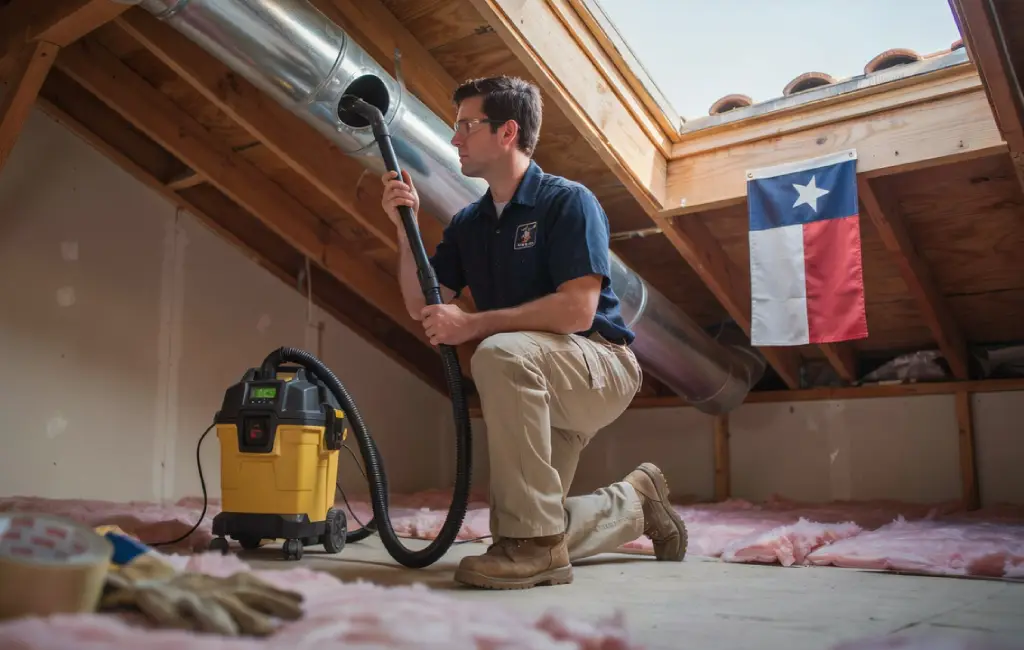
A portable shop-vac style unit, the kind a $49 operation shows up with, cannot create the same pressure differential. It can move debris from one location to another inside your system, but it cannot reliably extract it. The difference is not a marketing preference; it is physics.
When you call a company to ask about their equipment, ask specifically whether they use a truck-mounted vacuum system and whether their cleaning process creates negative air pressure throughout the duct network during the job. A credible company will explain this clearly because they understand it and are proud of it.
A company that responds vaguely or cannot explain the pressure differential principle is signalling an incomplete process. The HVAC duct cleaning process should be something the company can describe in plain language before they arrive, not a mystery they reveal once they’re inside your home.
Here is how a professional visit compares to what cut-rate operators typically deliver:
| Professional Duct Cleaning Visit | Cut-Rate Operation |
|---|---|
| Truck-mounted vacuum creating sustained negative air pressure | Portable vacuum unit; no consistent pressure differential |
| Full system scope: supply ducts, return ducts, air handler, coils, drain pans | Accessible vents only; scope defined by what’s quick |
| Rotary brush agitation to loosen debris before extraction | No mechanical agitation; surface-level suction only |
| Before-and-after photo documentation included | No documentation provided |
| Written scope of work provided before work begins | Verbal description only; scope expands after arrival |
| Single quoted price for complete job | Low entry price plus per-vent or per-“discovery” add-ons |
How Do You Evaluate Reviews and References for a Duct Cleaning Company?
Counting stars is the least reliable way to evaluate trustworthy air duct cleaner reviews. The information that actually tells you whether a company is worth hiring lives in the details, the specificity of individual reviews, the pattern of how the company responds, and where the reviews come from.
A company with 4.6 stars and 80 detailed reviews describing specific technicians and job conditions is a better candidate than a company with a perfect 5.0 from 12 reviews that all read like marketing copy. Learning to read reviews critically takes about five extra minutes and can save you a genuinely bad experience.
Duct cleaning reviews that are worth trusting tend to share observable characteristics. Authentic customer reviews name a technician, describe a specific condition they observed before or after the job, or reference a detail, the smell of the vents, what the technician showed them on the camera, how long the job took- that a paid reviewer or review-farming operation would not invent.
Generic five-star reviews that say only “great service, highly recommend” without any specifics are low-signal. They may be genuine, but they cannot be evaluated, which makes them nearly useless as a decision tool.
Green flags when reading reviews for a reliable duct cleaning service:
- Reviews mention a specific technician by name and describe their conduct
- Multiple reviews reference before-and-after photos or camera inspection as part of the job
- Reviews describe the company being honest about what the system needed (including “they told me I didn’t need a full cleaning yet”)
- The company responds to reviews, positive and negative, in a professional and specific way
- Review dates spread gradually over months and years, not clustered in a short burst
- Reviews appear consistently across multiple platforms, not concentrated on one site
- Red flags when reading reviews:
- Forty or more reviews posted within a single month after years of sparse activity
- All five-star reviews use similar phrasing or follow an identical structure
- No response from the company to any negative review, or defensive and dismissive responses
- Reviews that mention add-on fees or price changes that weren’t disclosed upfront
- No reviews on any platform other than the company’s own website

What Red Flags Should You Watch for Before and During a Duct Cleaning Appointment?
The clearest warning sign in this industry has a consistent pattern: an unusually low advertised price, a technician who arrives and discovers problems requiring expensive add-on treatments, and a final invoice that bears no resemblance to the original quote. This is the bait-and-switch, and it is common enough in Texas metro markets that knowing air duct cleaning scams to avoid in Dallas is the most practical protection available to you. The “$49 whole-house special” is not a discount, it is an opening bid in a negotiation you didn’t agree to have inside your own home.
Choosing duct cleaning company options based on price alone is the single most reliable way to end up with this experience. The advertised price is designed to get a technician through your front door. Everything that follows, per-vent fees, “discovered” mold treatments, mandatory sanitization, equipment surcharges, is how the actual invoice is constructed.
Final bills from these operations regularly reach $500 to $1,000 or more . A company that provides a written estimate with a complete scope of work before the appointment eliminates this pattern entirely, because there is no room to add undisclosed fees to a document you’ve already reviewed and agreed to.
Here is what specific red flags typically signal in practice:
| Red Flag | What It Usually Means |
|---|---|
| Advertised price far below market rate ($49-$99 “whole house”) | Bait-and-switch entry price; add-on fees will follow |
| No written estimate provided before the appointment | Pricing will be constructed on-site after access is gained |
| Cannot confirm NADCA membership when asked | No certification accountability; no published standard being followed |
| Refuses to send certificate of insurance in advance | Either uninsured or insurance doesn’t cover the scope of work |
| Technician “discovers” severe mold requiring immediate treatment | Documented pressure tactic; get a second opinion and a written report |
| Cash-only payment required | No paper trail; no recourse if work is disputed |
| Discourages you from watching the work | Work does not hold up to observation |
| Cannot name the equipment they use or explain negative air pressure | Using portable units and calling it professional cleaning |
What Questions Should You Ask Before Hiring an Air Duct Cleaning Company in Texas?
By the time you’re ready to call, you have enough information to evaluate any company in a short conversation. The goal of this checklist is not to interrogate a contractor, it is to ask the questions that a prepared, knowledgeable homeowner would ask, and to evaluate the answers honestly.
A company that answers these questions clearly, without hesitation, and without redirecting you away from verification steps is demonstrating exactly the behavior worth rewarding with your business.
When you call, work through these questions before you book:
- Are you currently a NADCA member, and can I verify that at NADCA.com using your company name?
- Do your technicians hold the ASCS (Air Systems Cleaning Specialist) certification?
- Can you send me a certificate of insurance, both general liability and workers’ compensation , before the appointment?
- Do you use a truck-mounted vacuum system, and can you explain how negative air pressure works during the cleaning?
- Can you provide a written, itemized estimate with a complete scope of work before the appointment starts?
- What exactly does your whole-house cleaning include , specifically, does it cover the air handler, return ducts, and coil area?
- Will you provide before-and-after photos of the system as part of the service record?
- Can you provide two or three references from jobs completed in the past 90 days?
Why Lara’s Air Duct Cleaning Is the Right Choice for Texas Homeowners
Letting an air duct cleaning company into your home means trusting their work. Lara’s Air Duct Cleaning was built to earn that trust before asking for your business, not after the technician opens your vents.
Owner accountability, not franchise layers.
When Lara’s name is on the business, the owner is personally responsible for every job. There is no franchise layer or subcontractor chain between you and the person answering if something goes wrong.
Professional equipment makes the difference.
You get truck-mounted negative air pressure cleaning. Not a portable unit that recirculates debris through your home. The equipment difference is the service difference.
Your price is your price.
Written estimates before every job mean no surprises on the invoice. No on-site upsells. No fees that appear only after the technician is inside your home.
Full licensing and insurance.
Lara’s carries general liability and workers’ compensation coverage. A certificate of insurance is available before your appointment without hesitation.
FAQs
Q: How do I know if an air duct cleaning company in Texas is properly licensed?
You can verify a company’s licensing status directly through the Texas Department of Licensing and Regulation at tdlr.texas.gov using the company name or license number. A legitimate company will provide their license number without hesitation when you ask; declining to share that information is a meaningful red flag, not an administrative inconvenience.
Q: How much does professional air duct cleaning cost in Texas, and what does it mean if a quote is much lower?
Fair pricing for professional whole-house air duct cleaning in Texas, including air duct cleaning cost in Dallas, reflects the size of your home, the complexity of your duct system, and the equipment required to do the job correctly. This typically falls within a range that a written, itemized estimate will make clear before any work begins.
Quotes that fall significantly below the market range almost always rely on add-on fees that surface once the technician is inside your home; a written scope of work provided before the appointment is the clearest protection you have against that outcome.
Q: Does air duct cleaning actually improve indoor air quality?
Whether air duct cleaning really works comes down to your specific system, not a blanket yes or no. The EPA notes that duct cleaning has not been shown to prevent health problems in every case, and the need for cleaning depends on specific conditions in a given home rather than a universal schedule that applies to all systems equally.
Systems with documented debris accumulation, confirmed mold presence, or contamination from recent renovation work can benefit meaningfully from professional cleaning.
Q: How often should I have my air ducts cleaned in Texas?
The EPA and NADCA generally suggest evaluating your system every three to five years, though Texas-specific conditions can reasonably affect that interval in either direction. Homes in high-humidity Gulf Coast regions, homes with pets or residents who have respiratory sensitivities, or homes that have recently undergone renovation may warrant more frequent evaluation.
A reputable company will assess your system’s actual condition rather than recommending a fixed schedule that serves their booking calendar rather than your home.
Q: What should a professional air duct cleaning visit include, and what should I ask before I book?
A complete professional visit should cover supply ducts, return ducts, registers, grilles, the air handler unit, and related system components, not only the vents a technician can reach quickly from the floor. Before you book, ask the company to confirm NADCA membership and point you to the verification page on NADCA.com, describe the specific equipment they use (and whether they use a truck-mounted vacuum system that creates negative air pressure), and provide a written scope of work and estimate in advance.
Any company that is unwilling to answer those questions clearly and directly before the appointment is telling you something important about how they will conduct themselves once they are inside your home.
Conclusion
Once you know what to look for, choosing a trustworthy air duct cleaning company in Texas becomes a straightforward process , and taking that step is worth doing now rather than after a low-ball offer has already cost you more than a fair job would have.
The certification standard exists for a reason: NADCA membership and ASCS credentials confirm that the technicians entering your home have been trained and tested, not simply recruited and dispatched. Texas licensing and liability insurance are not bureaucratic formalities; they are the specific protections that stand between you and real financial exposure if something goes wrong during a job.
And a written estimate with a clear scope of work is not an unusual request; it is the baseline of professional conduct, and any company that resists providing one is showing you exactly how they intend to do business.
You deserve a company that answers your questions honestly, shows up with the right equipment, documents the work it does, and charges you the price it quoted. Those standards are not difficult to meet; they just require a company that actually intends to meet them.
